
Welcome | Resources for liturgy | Liturgical ministries | Ministers of Music
Download pdf version 
Contents
The Advent season’s sound
The Advent season’s rituals
The Advent season’s challenges
An Advent season checklist for those who prepare music
Advent has a twofold character: as a time to prepare for the solemnity of Christmas when the Son of Godʼs first coming to us is remembered; as a season when that remembrance directs the mind and heart to await Christʼs Second Coming at the end of time. For these two reasons, the season of Advent is thus a period for devout and joyful expectation.
Advent begins with Evening Prayer I of the Sunday falling on or closest to 30 November and ends before Evening Prayer I of Christmas.
The Sundays of this season are named the First, Second, Third, and Fourth Sundays of Advent.
The weekdays from 17 December to 24 December inclusive serve to prepare more directly for the Lordʼs birth.
General Norms of the Liturgical Year and the Calendar, nn 39-42
The Advent season’s sound
Unique repertoire
The seasons of Advent and Christmas often have hymns and songs that are unique to the particular time of the liturgical year. This is different to Lent and Easter, where the Paschal themes in the music often give it greater versatility across Ordinary Time as well. Certain ‘Advent’ hymns (including classics such as O come, O come Emmanuel, for example) often define the experience of Advent for many parish communities.
Glory to God in the highest
The Gloria is not sung during the Advent season, except on specific occasions. It will certainly not be heard or sung across the four Sundays. The assembly will hopefully notice its absence and therefore notice its return at Christmas, opening with the angels’ joyful song of praise which the shepherds heard in the fields.
Discernment in the amount of music
In Advent, selecting what is sung and played should be guided by the fact that the season has a different character to the Christmas season to come. Particularly given that the broader community is often in ‘Christmas mode’ throughout December, music ministers share in the responsibility of maintaining the integrity of the Advent season. “At other times, the liturgical season calls for a certain musical restraint. In Advent, for example, musical instruments should be used with moderation and should not anticipate the full joy of the Nativity of the Lord” (Sing to the Lord: Music in Divine Worship, n 114).
Choice of music for parts of the Mass
Reflecting all of what has already been discussed in your music selections will make the Advent Masses sound different to what the assembly has experienced during Ordinary Time, and will experience during Christmas. In addition, music groups should choose a different “Mass setting” (or music for the assembly’s sung acclamations and prayers) for Advent, to reflect that each of the seasons at this time has its own character. The one set of music for these acclamations should be sung consistently throughout the Advent season and be changed again for Christmas.
The Advent season’s rituals
The Advent Wreath
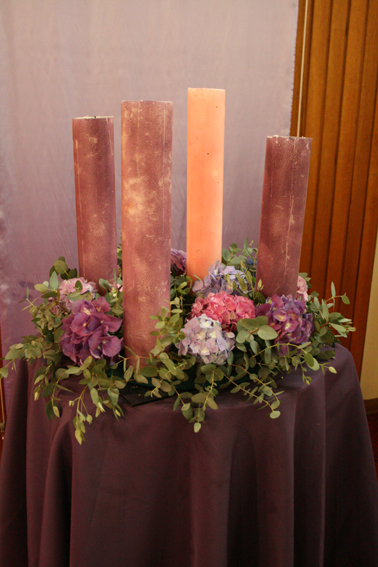
Many parishes include an Advent wreath as part of the seasonal art and environment at this time. The Book of Blessings offers a blessing for the wreath on the First Sunday. In a number of communities, however, it is a common pastoral practice to incorporate some focus on the Advent wreath and its lighting each week. It may be decided that this should include an acclamation, instrumental music or silence. Any such focus, however, should not replace the usual rituals of the Introductory Rites (ie Sign of the Cross, Greeting, Penitential Act and Collect Prayer).
Penitential Act
As mentioned above, the Penitential Act continues throughout this season, even though the Gloria is omitted. Advent can be a good time to use the second form (“Have mercy on us, O Lord…”) of the Penitential Act, as it echoes Scripture texts (Psalm 85) that are heard during the Advent season. If this form is used, then it is followed by the Kyrie (as explained in the video below), which can be sung using a setting that reflects the joyful hope and expectation of the season.
Responsorial Psalm
As always, the ideal for the Responsorial Psalm is that the text provided for the day in the Lectionary for Mass is sung. Our music suggestions provide the psalm of the day and name settings that are within our parish music collection. For music groups that find it challenging to learn a different psalm for each Sunday but want to ensure the integrity of singing the psalm, the Lectionary provides Common (or seasonal) Psalm texts for the season. Again, one of these is suggested each week in our music suggestions where appropriate.
View the nominated Common (or seasonal) Psalms for the Advent season
The Advent season’s challenges
Giving Advent its due
The season of Advent falls within what is a very busy time in Australia; the rush towards the end of the year, Christmas and summer holidays. It is only four Sundays long but, depending on when Christmas falls, the season’s length can vary from a full four weeks, to three weeks and one day (the Fourth Sunday can literally fall on Christmas Eve). Christmas dominates the retail world and the mind of the wider community. Music plays an important role in helping our communities retreat from the hustle and bustle and prepare for celebrating the true meaning of Christmas when the season comes.
Four Sundays
We must also consider the shortness of Advent along with its wealth of seasonally-specific music. Omitting this music altogether will make it hard for us to reflect the character of the season, while too much will mean the assembly does not have the time to build confidence in singing this material. Consider carefully choosing a small number of Advent hymns that can be used across more than one Sunday, and have the longevity to be used year after year. This principle is reflected in our music suggestions, particularly our Quick Pick Guides.
Not Lent
The nature of Advent as a preparatory season, the presence of the colour purple and John the Baptist’s call to repent can cause people to approach Advent and Lent in a similar way. In reality, however, they are very different seasons, each with their own character and focus. It is important for us to understand the uniqueness of the Advent season and reflect this in our preparations and the liturgical rituals our communities will engage in.
An Advent season checklist for those who prepare music
- Have we chosen music for the assembly’s prayers and acclamations that is different to Ordinary Time (and will be different to Christmas) and reflects the joyful expectation of Advent?
- Will we be singing the Penitential Act and/or Kyrie? Are we prepared for this?
- What is our community doing in regards to an Advent wreath?
- Is there a role for music here?
- Have we communicated to our music teams that the Gloria is omitted?
- How will we maintain rehearsal and preparation for Advent while rehearsing for Christmas?
- Are we prepared for singing the Responsorial Psalm?
- Will we use the psalm of the day or a Common text?
- Will the Masses we lead reflect some restraint in our use of music, to allow for more extensive use at Christmas?
- Are there hymns in our Advent repertoire that reflect the Scriptures associated with the season?
- How will we ensure that the joyful expectation of Advent is reflected in our music and leadership throughout the season?
 Liturgy